Leadership in General Practice
“Leadership is about making significant change happen at a human level. It’s also about making a difference.”
Preface
Leadership is a key skill for General Practitioners. We are all leaders within our teams. Becoming better leaders can help us to deliver excellent patient care. Learn more about yourself and about leadership in this webpage with content from Dr Amar Rughani, Samantha Wong and Liddy Mawer. I highly recommend this article.
Nicholas Boeckx
TPD (former Coventry & Warwickshire)
Head, Heart and Hands
When changes are small-scale and don’t involve many people to a great degree, leadership is not needed. However, most of the challenges that we face in primary care are complicated and involve many people. The context that we are working in is complex for two reasons. Firstly, there often isn’t an obvious way forward and many factors have to be taken into account. Secondly, the issues affect real people and in this age of global communication, these people are in touch with each other and expect to be involved, not just informed.
To help people work through complex problems, we need leadership that is able to work with people and facilitate the process of change. The significant change is made by the whole group, of which the leader is a part. The leader contributes to the group effort by being a driver of change.
Leadership is also about making a difference, which every human being has the capacity to do. Tragically, too many people do not feel that they are of account or that their thoughts and ideas might help the team to develop. This is wrong. Nobody is nobody. Part of our challenge as leaders is to change the culture so everybody recognises that potential and the opportunity to make a difference.
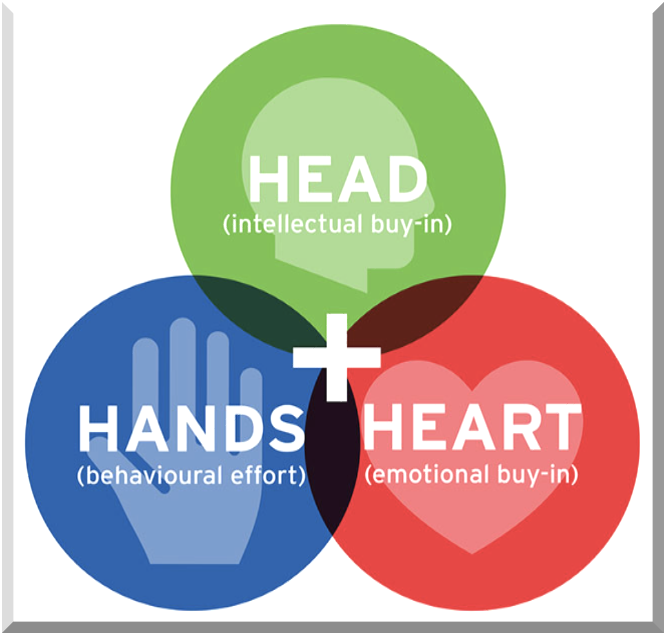
(The Head, Heart and Hands model of employee engagement is intellectual property of Edgecumbe Consulting Group Ltd.)
Primary Colours® Model of Leadership
If change is made by a team, what skills do the team need?
This intuitive diagram shows that we need a combination of head, heart and hands skills, in other words thinking about what we need to do (head), relating to people so that they feel involved (heart), and doing things to make change happen (hands).
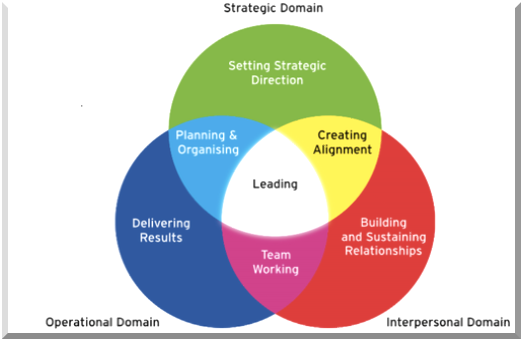
(The Primary Colours® Model is a registered trademark of Edgecumbe Consulting Group Ltd. Used with acknowledgement.)
Based on Pendleton, D., Furnham, A., & Cowell, L. (2011). Leadership: All You Need to Know. Palgrave Macmillan.
This slide is called the Primary Colours® model of leadership developed by David Pendleton et al. It gives the head, heart and hands different names in terms of the tasks needed to be accomplished for change to happen. We can think of this as a clockwise circle starting with the green area.
Green Zone
Change often happens by thinking about what needs to change and why, what the options are, what is going on elsewhere that we might learn from, what the literature says, and so on.
Red Zone
Once ideas have been developed we move into the red area in which they are discussed more widely in the workforce. This process will involve engaging with people, hearing their thoughts, encouraging them to challenge the ideas to make sure that they are robust. Through this process, alignment is created between what people feel they are prepared to do and what the thinkers suggest we need to do. Without alignment, we can go no further. If we try to force the issue and tell people to comply, the project will fail.
In the red zone, there is much to do with building and maintaining relationships. Here, people need to be nurtured, involved and supported in their new or modified roles.
Blue Zone
Working with people is not just about being nice to them or nurturing them. Because we have to deliver results, the clockwise arrow moves into the delivery zone. In the overlapping area labelled “team working” we have to encourage and sometimes push people into meeting agreed objectives. In the blue zone, people and projects are managed so that results are delivered.
Complementary Skills
The Primary Colours® model shows the skills that are needed for change to happen. The most important thing to remember is that these skills have to be present within the whole team. This does not mean that all the skills can be present within one person. In fact, we know from studies of effective leaders that nobody can be skilled in every area to an exceptional degree. To be good in some areas necessarily means that you will be less good in others.
Think of Jessica Ennis, the heptathlete who has the ability to be very good at running and jumping. She is not so good at throwing. However, Valerie Adams from New Zealand is the opposite. If Jess tried to develop the muscles that Valerie has for throwing the shot put, she wouldn’t be able to hurdle and would be mediocre at everything rather than exceptional at some. It’s pointless asking which of them is the better athlete. The main thing is that they are both world-class because they have worked on their natural strengths to be the best that they are capable of. That’s the challenge for us. We need to understand ourselves far more deeply, so that we can work on our strengths and be the best John, Sue, Deepak and Li that we can.
This is not an egotistical exercise. By being the best that we can be, we contribute hugely to the effectiveness of our teams. We become Team GB, not just Jessica Ennis.
Personality and Leadership
Tests of Self
Link to the Belbin Team Roles Inventory
Link to the Personality Inventory
Before continuing it will help if you complete the Belbin Team Roles Inventory and the Personality Inventory. Links to both are given above.
The personality test that you have done will show you how you stand in relation to five axes. The data from which this survey is drawn is based on large populations and therefore says something about people in general, rather than you in particular. No test will ever tell you the whole truth about yourself, so when you find yourself getting irritated or disagreeing with the outcomes, remember that point.
It is said that these five dimensions of personality are relatively fixed in early adult life. Personality does not mean that you necessarily behave in these ways. It simply gives you a critical insight into what your personal biases are. More specifically, the test shows you how, unless you choose to do otherwise, you are inclined to think, feel and act.
We therefore find that the manifestation of our personality will be different depending on who we are with, what we are engaged in, how we are feeling physically or emotionally, and so on. This doesn’t mean that our personality keeps shifting; it just means that our behaviour is different. Understanding our personality and therefore the biases that are just part of who we are is the key to being able to knowingly change our behaviour and in time change our attitudes, so that we are more effective and “better” people.
The words can seem a bit pejorative, for example “neurotic”. Just take these words as labels rather than value judgements.
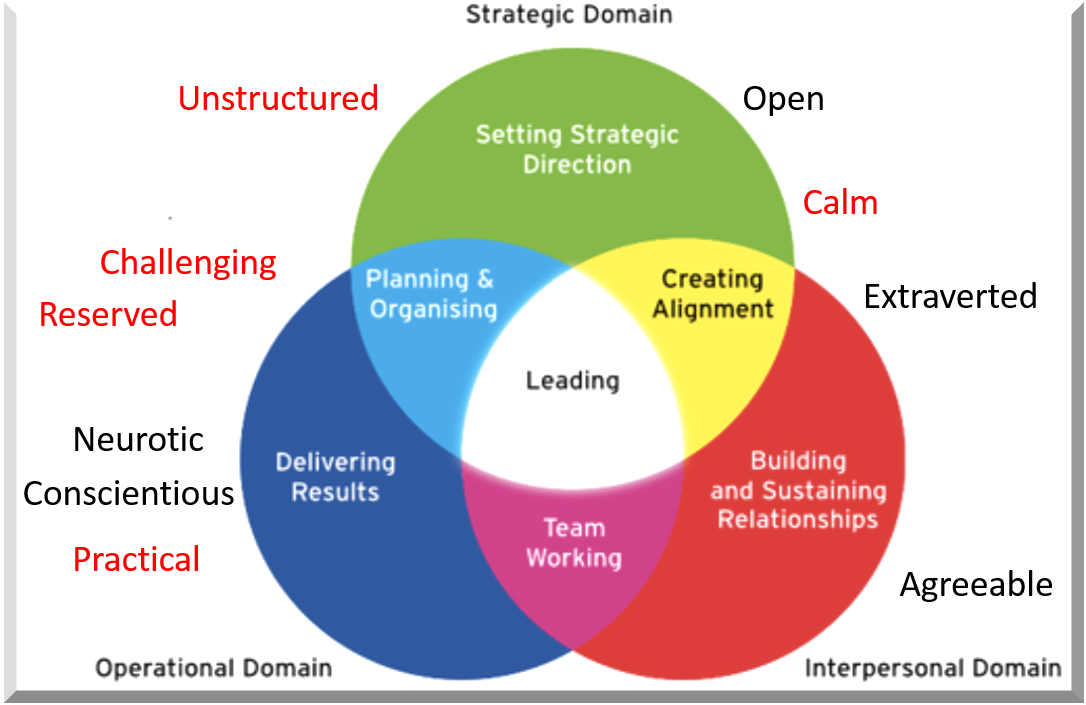
Big Five Traits and Leadership
In this slide, red labels indicate characteristics at the low-scoring end of each of the Big Five personality characteristics:
- Open…Practical
- Conscientious…Unstructured
- Extraverted…Reserved
- Agreeable…Challenging
- Neurotic…Calm
Now let’s look at each of these words, which represent the extreme end of each scale, and think about how each characteristic, whether scoring high or low, is a strength because each of them contributes something to the range of skills that leadership requires, as shown by the Primary Colours® model.
Open (Green)
This reflects imagination, the ability to think critically and to reflect. Open-minded people seek variety and change and are good at thinking afresh about problem areas.
Practical (Blue)
At the opposite end of the openness scale, people prefer to be practical, concrete and down-to-earth. They are good at getting on and delivering.
Conscientious (Blue)
These people have high standards and a high level of focus on achieving goals. They are well organised and therefore excellent at delivering and contributing to planning and organising.
Unstructured (Green)
At the other end of conscientiousness, people can be a bit disorganised and not particularly reliable. However, there is strength here because such people don’t invest much in being structured and limited by boundaries. They are therefore more inclined to show openness and contribute to the creative “blue sky” thinking that is needed in the green area.
Extroverted (Red)
Extroversion is principally a people‑orientated characteristic. Such people prefer to be around others and derive their high energy from social interactions. Sometimes other people, particularly introverts, can find them pushy, dominant and draining. However, this sociability helps in the red area. Their energy and drive can also help with creating alignment and with team working.
Reserved (Blue)
Reserved people prefer to be alone or quiet. This helps to balance the energy in the group. Being reserved aids reflection, which can contribute to the green area where insight and balanced judgement are important. In addition, being reserved may help with concentration and focus, with benefits to the blue area of delivery.
Agreeable (Red)
Agreeable people are cooperative and sympathetic. They help to sustain motivation, which is a key factor in achieving significant change. They tend not to be comfortable with standing up to people and will avoid conflict, but this helps their natural ability to be diplomats and to help people compromise and work towards a negotiated solution.
Challenging (Green, Team Working, Blue)
Challenging people may not be easy to live with, but they are indispensable. Being challenging does not mean being destructive; we are talking here about constructive dissent. In the green zone, challenge can ensure that there is a brake on the process. In team working and blue zones, challenge can ensure that we keep people to task rather than just support them in an unquestioning way.
Neurotic (Blue)
People with higher neuroticism scores are sensitive to detail and feel the effects emotionally if detail is not given due attention. They are great at obsessing over small details and making sure that tasks are completed to a professional standard.
Calm (Green and Red)
Low scores on neuroticism indicate a relaxed and calm demeanour, for example being good in a crisis or when under stress. In the green zone, this can encourage balanced judgement. In the red, calm people can help to defuse emotionally charged situations and support colleagues through anxiety associated with change.
Belbin Team Roles
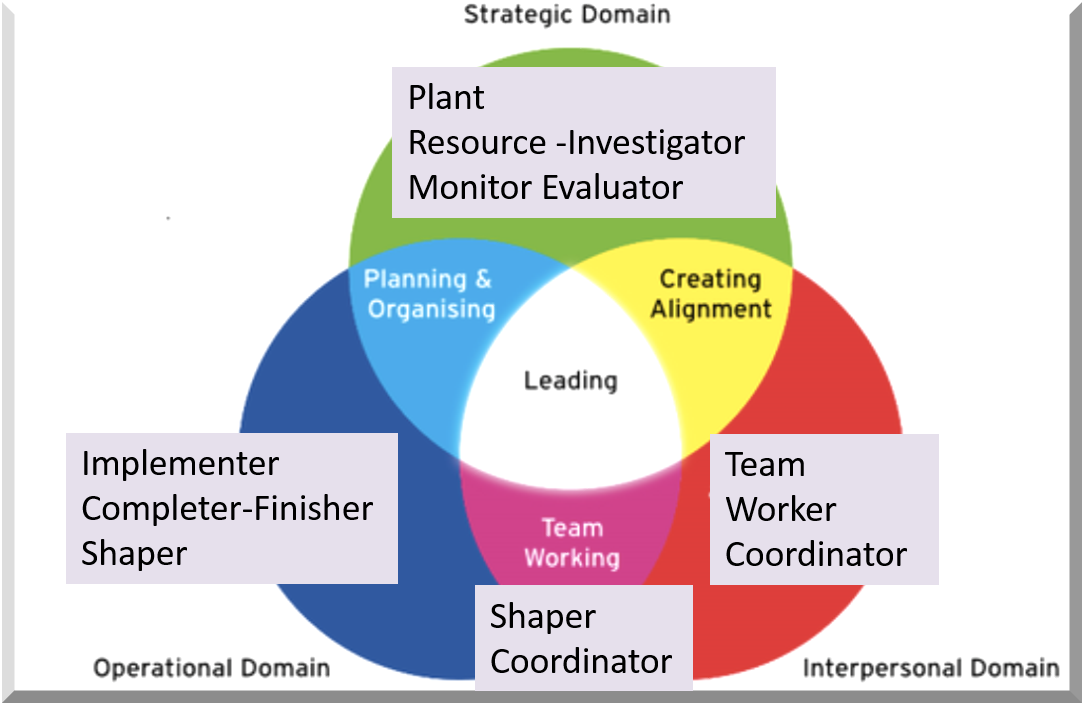
This slide shows the roles that people find themselves in. The questionnaire that you have completed gives you an idea of your role preferences. Probably the top two or three preferences are the most important for you to consider. The role that you feel comfortable in may change during the course of your career.
Shaper (Team Working & Blue)
Shapers need to achieve and have a strong drive. They can overcome obstacles and even thrive on confrontation. They will challenge inertia and complacency and in doing so may offend others, but they are particularly helpful in management roles where their drive and courage helps the team to deliver.
Coordinator (Team Working & Red)
Coordinators are good in relationships, able to spot talent and place people in positions where they can contribute to common goals. They are good at delegating and keeping people on board.
Plant (Green)
Plants are individualistic, serious‑minded and often unorthodox. They are innovative and can be highly creative, providing the seeds of ideas from which major developments spring.
Resource Investigator (Green)
Resource investigators are curious and communicative. They network well, are interested in what’s going on elsewhere and seek out other people’s ideas which they then use back at base to exploit opportunities.
Monitor Evaluator (Green)
Monitor evaluators are serious‑minded, sober and relatively unemotional. They contribute to the thinking process because they are able to look objectively and dispassionately at the facts and come to shrewd judgements.
Implementer (Blue)
Implementers are practical people who will look at a given situation and work out systematically what needs to be done and what is feasible. They are very good at planning and organising and are usually loyal to the organisation.
Team Worker (Red)
Team workers are mild and sociable people and like to get on. They relate very well to others partly because they are good listeners and able to adapt to different types of people. They are able to understand and value diversity.
Completer Finisher (Blue)
Completer finishers are painstaking and anxious people. They have very high standards, seldom start what they cannot finish and have enormous attention to detail.
Kotter’s Stages of Change
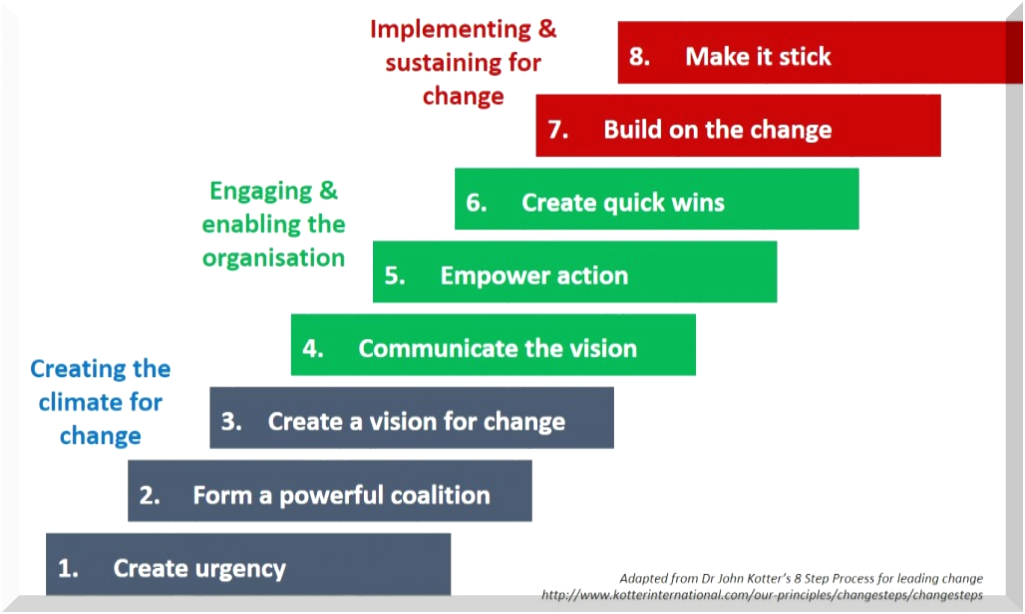
We looked in detail at the skills that a team need to make change happen. Another way of looking at change is through this helpful model produced by John Kotter of Harvard Business School.
He talks about eight stages. These are not necessarily sequential as sometimes we have to come back to earlier stages to reinforce them. It is helpful to think about projects that we have been involved in and to reflect on whether the eight stages were attended to.
Knowing the stages can help us to think ahead and plan for stages that we know are to come. For example, when we sell a new idea and get people on board, they are usually energised by the vision and the prospect of a better future (“uninformed optimism”). Later, energy and enthusiasm may drain as people appreciate the personal effort that change involves (“informed pessimism”). Planning for a “quick win” can help to reinvigorate people.
Practical Leadership Exercise: A Fresh Set of Eyes
A Fresh Set of Eyes
Many organisations, usually forward‑thinking businesses rather than institutions, recognise the value of new people in the organisation and the fresh pair of eyes that they bring.
New people within the first few weeks will be asking themselves questions like:
- Why are we doing this?
- Why are we doing this in this way?
- I’ve seen this problem dealt with differently (and better) elsewhere.
- That’s really great! Why haven’t other people done it the way that you do?
Try using this mindset in your own organisation and come up with two or three suggestions for change which, to you, are priorities based on your observations. Then present these to the team and make a pitch for what needs changing and why.
You will learn a lot about how to look afresh at what’s going on around you, how to prioritise and make a case for change and finally, how to persuade people and win them round to either your point of view or, through negotiation, to an objective that you can mutually agree on.
References
- Pendleton, D., Furnham, A., & Cowell, L. (2011). Leadership: All You Need to Know. Palgrave Macmillan.
- The Primary Colours® Model is a registered trademark of Edgecumbe Consulting Group Ltd. Used with acknowledgement.